Title & Description Length Checker
Craft the perfect Google snippet with our Meta Title & Description Length Checker. In 2025, winning the click is just as important as the ranking. Our tool provides precise pixel-width measurements and AI-powered suggestions to ensure your search appearance is clean, professional, and optimized for maximum CTR.
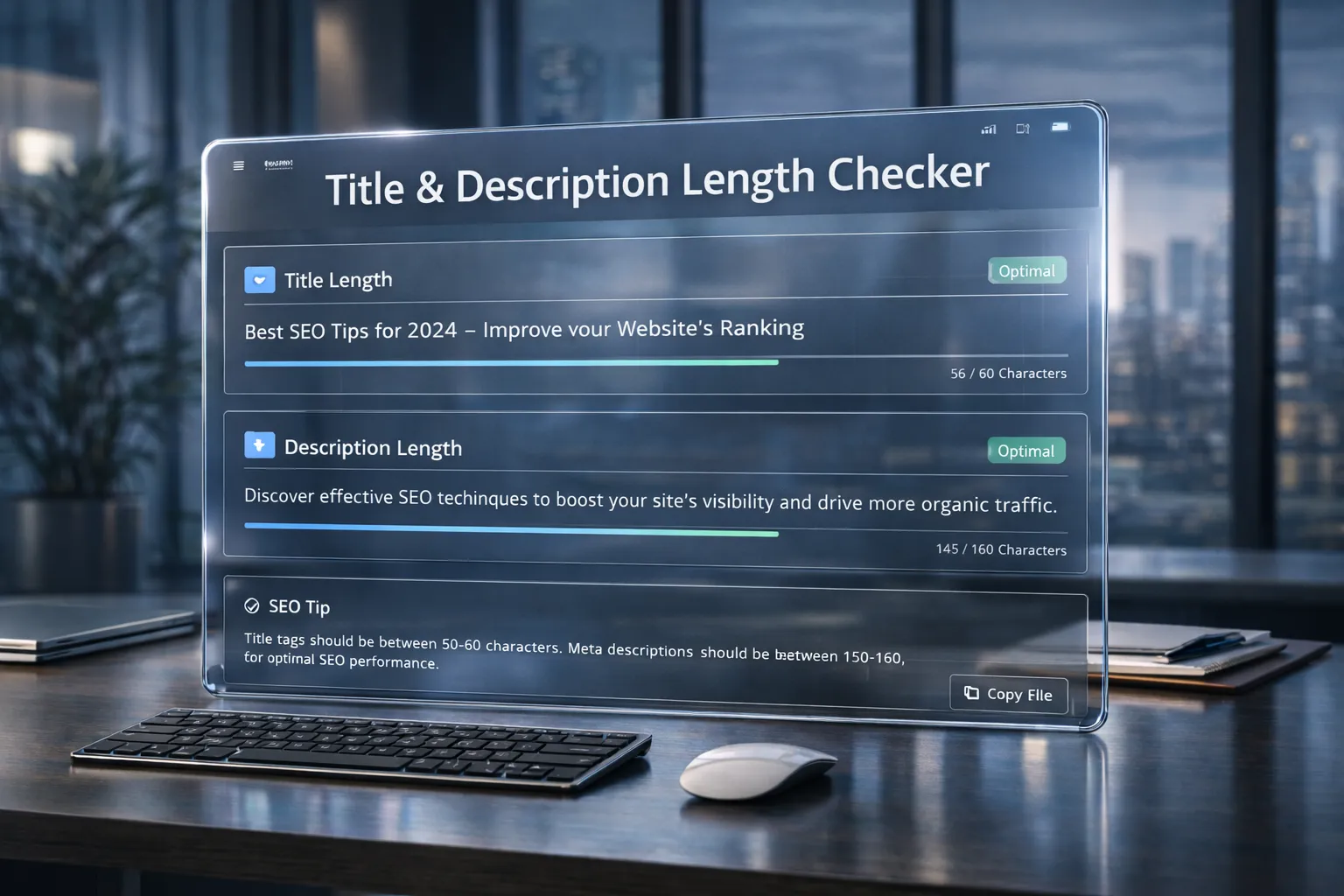
The Ultimate Guide to Meta Title & Description Optimization: Mastering the Google SERP in 2025
In the competitive landscape of digital marketing, your search engine result snippet is your first—and often only—opportunity to make an impression on a potential visitor. Understanding the nuances of a Meta Title & Description Length Checker is not just about counting characters; it's about strategic CTR optimization, psychological triggers, and technical precision. Whether you are a small business owner or part of an enterprise SEO strategy team, mastering your SERP appearance is a non-negotiable skill.
1. What is a Meta Title and Description? The Gateway to Your Website
Before diving into the technicalities of a pixel width checker, let's define the core elements of a search engine result snippet.
The Meta Title (Title Tag)
The meta title is an HTML element that specifies the title of a web page. It's displayed on search engine results pages (SERPs) as the clickable headline for a given result. It's also visible at the top of a web browser and when a page is shared on social media.
The Meta Description
The meta description is a brief summary of a page's content, typically around 150-160 characters long. While it’s not a direct ranking factor in Google’s algorithm, it plays a massive role in increasing click-through rates (CTR). A compelling description convinces the user that your page has the answer they are looking for.
2. Why Pixel Width is the Only Metric That Truly Matters
For years, the SEO community relied solely on character counts. However, modern search engines like Google and Bing use a more precise method: pixel width.
The Problem with Character Counts
Consider the difference between a capital 'W' and a lowercase 'i'. The 'W' takes up significantly more horizontal space than the 'i'. If you exclusively use character counts, you might find that a short title with many wide characters gets truncated, while a long title with narrow characters fits perfectly.
The Google Display Limit
On desktop, Google typically displays titles up to approximately 600 pixels. For descriptions, the limit is roughly 960 pixels. A professional SERP preview tool must calculate these pixel widths to provide an accurate representation of how your snippet will appear in the wild. Our tool is engineered to provide these precise measurements, ensuring your most important keywords and calls-to-action are never hidden behind an ellipsis (...).
3. The Psychology of the Click: How to Increase Click-Through Rates (CTR)
Ranking #1 is fantastic, but it's worthless if nobody clicks. High-value SEO is as much about psychology as it is about technology. When you target high CPC keywords for SEO, you are often competing against well-funded corporations. To win, your snippet must be more inviting than theirs.
Using Power Words and Emotional Triggers
Don't just describe your content; sell it. Use power words that evoke curiosity, urgency, or authority:
- Curiosity: "The Secret To...", "What You Didn't Know About..."
- Urgency: "Limited Time," "Stop Making This Mistake," "Instant Access."
- Authority: "Professional Guide," "Expert Analysis," "Case Study."
The "Call to Action" (CTA)
Every meta description should include a subtle or direct CTA. Words like "Learn more," "Discover how," "Download now," or "Get started" guide the user toward the next step.
Addressing Search Intent
Understand why the user is searching for a particular term. Are they looking for information (Informational Intent), comparing products (Commercial Intent), or ready to buy (Transactional Intent)? Align your title and description with that intent to maximize relevance.
4. On-Page SEO Checklist for Meta Tags in 2025
A comprehensive on-page SEO service involves more than just setting a title. It requires a holistic approach. Use this checklist for every page you optimize:
- Primary Keyword Placement: Place your main keyword near the beginning of the title tag. This helps both search engines and users quickly identify the topic.
- Unique Titles for Every Page: Never duplicate titles across your site. Each page serves a unique purpose and should have a unique identifier.
- Avoid Keyword Stuffing: Don't just list keywords. Create a natural, readable headline and summary. Google may rewrite your snippet if it detects manipulation.
- Incorporate LSI Keywords: Use semantically related terms in your description to provide broader context to search engines.
- Match the URL: Ensure your URL structure is clean and reflects the title of the page.
- Use Rich Snippets (Schema Markup): While not part of the Title/Description tags themselves, Schema.org markup can add stars, prices, or FAQ sections to your snippet, making it significantly more prominent.
5. Enterprise SEO Strategy: Scaling Meta Tag Optimization
For large-scale websites with thousands or millions of pages, manual optimization is impossible. An enterprise SEO strategy requires a blend of automation and human oversight.
Template-Based Optimization
Use variables to generate titles and descriptions at scale. For an e-commerce site, a template might look like:
[Product Name] - Buy Online at [Store Name] | Free Shipping
AI-Powered Suggestion Engines
Our Meta Title & Description Length Checker includes an AI-integrated generator. This is a game-changer for large sites. Our AI analyzes your page content and generates dozens of variations optimized for both length and conversion potential, allowing you to pick the best one in seconds.
Data-Driven Testing (A/B Testing)
Don't guess; test. High-traffic sites can use tools to A/B test different meta tags to see which one performs better. A 1% increase in CTR on a page with 100,000 monthly impressions means an extra 1,000 visitors for free.
6. How to Use Our SERP Preview Tool for Maximum Impact
Getting the most out of our tool requires a strategic approach. Follow these steps:
Step 1: Input Your Content
Enter your proposed title and description. Our tool will instantly show you the character count and the pixel width.
Step 2: Check for Truncation
Watch the live preview. If your text turns red or gets cut off with an ellipsis, shorten it. Focus on keeping the core value proposition within the visible area.
Step 3: Analyze Focus Keyword Visibility
Does your target keyword stand out? It should be bolded (or appear early) to catch the eye of the searcher.
Step 4: Utilize AI Suggestions
If you're stuck, click the 'Generate' button. Our AI will provide a variety of creative options based on your keywords and target audience.
7. The Competitive Edge: Analyzing the Competition
One of the best uses for a Meta Title Checker is to audit your competitors.
Step-by-Step Competitive Audit
- Search for your target keyword on Google.
- Identify the top 3 results.
- Copy their titles and descriptions into our tool.
- Analyze their structure. Do they use numbers? Brackets? Questions?
- Find a way to make your snippet better. If they are all being "professional," try being "bold" or "direct."
8. Technical Considerations: Beyond the Visuals
While the SERP preview is visual, there are technical aspects to consider.
Character Encoding
Ensure your site uses UTF-8 encoding. If your CMS doesn't handle special characters properly, they might show up as garbled text in the search results, destroying your credibility.
Google's Snippet Rewriting
It's important to know that Google doesn't always use the meta description you provide. If Google's algorithm thinks a snippet from the page content is more relevant to the user's specific query, it will display that instead. However, providing a high-quality, relevant description increases the likelihood that Google will use yours.
9. Frequently Asked Questions (FAQs)
What is the ideal length for a meta title in 2025?
Generally, keep your title between 50-60 characters or under 600 pixels. This ensures it fits on both desktop and mobile devices.
How long should a meta description be?
Aim for 120-155 characters or under 960 pixels. Shorter descriptions work better on mobile, while longer ones fill the space on desktop.
Does a long meta description hurt my SEO?
No, it doesn't hurt your rankings directly. However, it will be truncated, which might hide your call-to-action and lower your CTR.
Can I use emojis in my meta tags?
Yes! Emojis can help your snippet stand out. However, use them sparingly and ensure they are relevant to your brand. Not all browsers or search engines display all emojis.
How often should I update my meta tags?
SEO is an iterative process. You should audit your top-performing pages at least once every six months to see if you can further optimize the CTR based on current search trends.
10. Conclusion: Your Gateway to Higher Rankings and More Clicks
A perfectly optimized meta title and description are the foundation of a successful digital presence. By using a Meta Title & Description Length Checker that focuses on pixel width, you are moving beyond guesswork and into the realm of data-driven precision.
Combine this technical accuracy with a deep understanding of your audience's psychology, and you will create snippets that not only rank but also dominate the search results. Start optimizing your SERP appearance today and watch your traffic—and your ROI—grow.
For more technical insights, you can review Google's official guide on influencing your title links and their best practices for meta descriptions.