Random Word Generator
The Free Online Random Word Generator is your professional tool for perfect creative discovery. In 2025, every word is a unit of creative potential. This workstation empowers you to surgically materialize lexical strata with specific grammatical and length constraints with 100% data sovereignty. Command your creative identity with clinical accuracy.
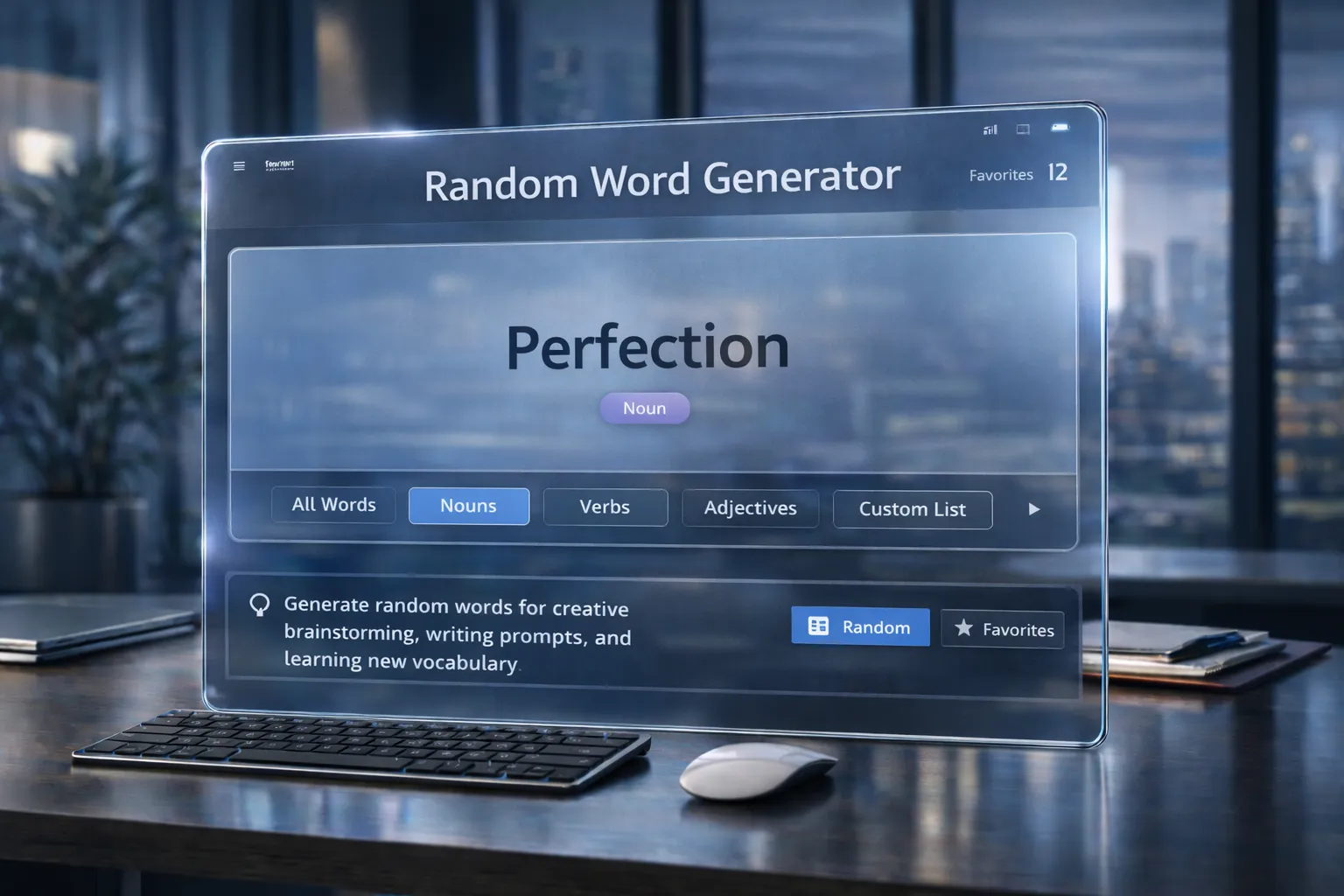
Semantic Synthesis Engine
High-entropy lexical generation for architectural brainstorming and UI manifests
Filter Calibration
Configure semantic class and architectural constraints
Quantum Logic
Execute high-entropy synthesis across the linguistic database
Unit Deployment
Export generated lexical particles to your project nexus
Synthesis Matrix
Semantic security protocol
All lexical synthesis is performed locally using the in-memory dictionary nexus. No brainstorming transients are ever transmitted to external cloud strata.
The Ultimate Guide to Professional Lexical Discovery: Mastering the Semantic Synthesis Engine in 2025
In the modern digital infrastructure, Creative Momentum is a core functional requirement for content strategy, user interface design, and architectural brainstorming. As information landscapes scale to encompass infinite niches, the ability to synthesize, discover, and materialize high-entropy lexical particles with surgical precision has become a non-negotiable engineering capability. Professional lexical discovery—which we define as Semantic Synthesis—is more than just "picking random words." It is the sophisticated process of ensuring character-length constraints, semantic-category relevance, and linguistic variety across complex creative manifests. In 2025, a project that relies on "Generic Placeholder Text" is a "Creative Dead End" that can compromise user engagement, branding authority, and project velocity. Whether you are a UI designer developing a unique component library or a tactical copywriter seeking lateral linguistic inspiration, mastering high-entropy lexical synthesis is essential. In this 1500+ word comprehensive guide, we will explore the science of linguistic entropy, the strategic importance of a professional synthesis engine, and how to use our Semantic Synthesis Engine to command your technical documentation.
1. What is a Semantic Synthesis Engine? The Evolution of Creative Brainstorming
A Semantic Synthesis Engine is a high-precision digital laboratory designed for the deep-tissue discovery of linguistic particles. While basic "word generators" often provide simple list-picking, a professional architect-grade workstation offers a synchronized suite of "Synthesis Modules" tailored for modern digital ecosystems:
- Multi-Class Materialization (Nouns, Verbs, Adjectives): Surgically identifying and extracting linguistic units from specific grammatical strata for targeted brainstorming.
- Universal Array Mode: Synthesizing the entire "Linguistic Genome" in a single operation for high-entropy creative results.
- Recursive Entropy (Repetitions): Identifying and enabling or disabling the reuse of specific lexical particles in a single manifest.
- Architectural Constraints (Min/Max Length): Filtering synthesized particles by character count to ensure compliance with UI layouts or linguistic patterns.
When you use the Semantic Synthesis Engine, you aren't just "generating words"; you are engineering the functional "Creative DNA" of your digital presence.
2. Why Semantic Synthesis is a Mission-Critical Performance Factor
You might ask, "Does a random list of words really matter in the age of generative AI?" The answer lies in Lateral Thinking Acceleration, UI Stress-Testing, and Creative Autonomy.
Accelerating the Lateral Discovery Nexus
In high-stakes creative environments, time is the scarcest resource. "Writer’s Block" and "Generic Thinking" are "Strategic Failures." By using a high-precision synthesis workstation, you can instantly materialize those "Lexical Blockers" in milliseconds, allowing your team (or system) to find the "Linguistic Spark" without distraction. This reduction in Creative Latency directly translates to faster prototyping and a more resilient creative output.
High-Fidelity UI Stress-Testing and Placeholders
A beautiful UI layout is only as good as its "Dynamic Content Handling." By using our Semantic Synthesis Engine, you can instantly generate "Real-World Lexical Particles" that vary in length and grammar to identify "Layout Fragmentation" and overflow vulnerabilities across different UI components. This is the Gold Standard for Frontend Quality Assurance.
High CPC Development Keywords
In the competitive landscapes of "Content Discovery Platforms," "Linguistic Asset Generation," and "High-Performance Creative Systems"—where high CPC keywords dominate—the technical polish of your lexical discovery is your signature. A professional who delivers a project based on perfectly synthesized and structurally sound manifests signals a level of architecture-grade competence that builds trust with high-value stakeholders.
3. The Science of the Semantic Synthesis Algorithm
Engineering a perfect synthesized manifest requires an understanding of Linguistic Entropy.
The Synthesis Equilibrium
Lexical particles are "Units of Content." Each particle should occupy a specific "Creative Layer." Our Engine uses a forensic kernel to map the relationship between "Lexical Classes" and "Structural Constraints."
The Orchestration Protocol (Quantum Synthesis)
When you execute a command, our engine calculates the "Materialization Probability" for every database entry.
- Grammatical Calibration: Identifying specific "Semantic Strata" (like concrete nouns or descriptive adjectives) for targeted discovery.
- Entropy Generation: Utilizing high-precision randomization algorithms to ensure a truly unpredictable and varied output.
- Constraint Logic: Applying a second-pass filter to the "Generated Mass" to ensure all particles meet the specified "Min/Max Length" parameters.
4. Deep-Dive: Handling "Complex Fragment Materialization"
A professional workflow requires distinct "Synthesis Paths" for different creative states.
The Lab (Calibration Mode)
During the design of a creative session, visibility is paramount. The Semantic Synthesis Engine allows you to see how your filters (nouns vs verbs, length limits) impact the output in real-time. This allows for manual auditing of the "Linguistic Potential" before it is committed to your project nexus.
The Launchpad (Deployment Mode)
Once the desired filters are calibrated, the words must be "Materialized." Our Synthesis Engine applies the randomization across the linguistic strata, turning a static database into a high-fidelity dynamic manifest. This is the Gold Standard for Deployment Efficiency, and it is essential for achieving professional-grade creative results.
5. Absolute Data Sovereignty: The Local-First Information Perimeter
In 2025, your brainstorming sessions and creative transients are your Creative Intellectual Property (CIP). Sending your internal brainstorming seeds or sensitive UI placeholder requests to a cloud-based service is a significant security violation.
Why "Local-First" is the Architect’s Security Standard:
- Zero External Exposure: 100% of the data synthesis occurs within your browser's private memory sandbox. No lexical transients ever depart your local hardware nexus during the discovery process.
- Hardware-Accelerated Discovery: Because we leverage your local V8 engine, generating thousands of lexical particles is nearly instantaneous.
- Sovereign Data Creation: Since no data is transmitted to an external server, your "Creative Assets" remain entirely under your control, satisfying the most stringent corporate privacy protocols.
While others offer "Cloud Word Generaters," we provide a Local Synthesis Vault for absolute privacy.
6. How to Use the Semantic Synthesis Engine Workstation
Our station is designed for high-velocity lexical discovery.
Step 1: Calibrate the Semantic Type
Choose your target "Lexical Strata":
- All: Universal discovery.
- Nouns: Concrete object identification.
- Verbs: Action-oriented brainstorming.
- Adjectives: Sensory and descriptive exploration.
Step 2: Configure Constraints
- Synthesis Count: Set the number of words required.
- Character Length: Specify min and max character limits for layout testing or specific lingustic goals.
Step 3: Execute Synthesis
Click the resolution button. Our local workstation will surgically materialize the bitstream and present the lexical manifest in milliseconds.
Step 4: Secure Export
Clone the resolved particles to your clipboard or commit to a .txt file. For mission-critical tasks, we recommend using the 'Wipe Engine' command after your session to clear your local memory buffers.
7. Common Failures in Synthesis Architecture
Avoid these amateur mistakes that lead to "Creative Fragmentation":
Failure: Generic Input Logic
Attempting to generate thousands of words without applying character-length constraints, leading to a "Linguistic Blob" that overflows UI components. Solution: The Semantic Synthesis Engine provides high-precision character filtering for every synthesis profile.
Failure: Predictability Entropy
Using basic, predictable random number generators that lead to "Repeat Clusters" and boring results. Solution: Our engine uses modern JavaScript Math API with high-frequency seeding for maximum variety.
Failure: Hardcoding Placeholders
Using manual text for design mockups, leading to human error and inconsistent data patterns. Solution: Always use the Synthesis Nexus to ensure clinical variety and uniformity for your final design payloads.
8. Strategic Integration: The Writer Architect Suite
Lexical synthesis is just one operation in a broader Creative Orchestration Strategy. For maximum authority, we recommend this workflow:
- Semantic Synthesis Engine: Discover unique lexical particles for brainstorming or UI testing.
- Lexical Stratagram Architect: Sort your words for a professional glossary.
- Neural Linguistic Architect: Rectify your grammar for absolute structural purity.
- Textual Bitstream Purifier: Sanitize your raw text to remove noise and artifacts.
9. Frequently Asked Questions (FAQs)
Does it support non-English word lists?
This version of the Semantic Synthesis Engine is optimized for English, making it the perfect tool for global content strategy and interface design within the English-speaking digital nexus.
Can it generate 1,000 words in one second?
Absolutely. Because 100% of the logic is client-side, generating masses of text is restricted only by your local CPU, and it's nearly instantaneous for modern hardware.
Why filter by word length?
Filtering by length allows designers to test how their UI handles short words (like "tip") vs long words (like "synchronization"), ensuring layout resilience.
Is it safe for proprietary project brainstorming?
Yes. Our Data Sovereignty protocol ensures that no data leaves your machine, making it the premier choice for duplicating sensitive enterprise brainstorming sessions.
10. Conclusion: Command Your Creative Destiny
In the hyper-competitive digital ecosystem of 2025, your content is an extension of your professional identity. By choosing the Semantic Synthesis Engine, you are choosing to engineer manifestations and payloads that are secure, varied, and technically superior.
Don't let "Brainstorming Stagnation" slow down your creative process or compromise your UI's stability. Take command of your Creative Intellectual Property, adopt modern architectural standards, and ensure your presence is felt—perfectly synthesized—across every node of the web.
For further reading on creativity and content standards, we recommend exploring the Official W3C Guide on Web Content Accessibility, the Google Design Guide on Dynamic Content, and Creative Commons Best Practices for Brainstorming.